
CHAPTER 01
Background & Vision
1.1The Dilemma of Centralized AI
As artificial intelligence technology continues to advance, AI has been widely applied to:
- Intelligent customer service
- Financial risk control
- Automated decision-making
- AI Agents
- Real-time inference networks
However, most AI services today still rely on centralized GPU clusters and closed computing platforms.
While this structure improves computational efficiency, it also introduces several problems:
- Concentrated compute resources
- Insufficient node coordination
- Unverifiable AI inference
- Low resource utilization
- Difficult edge AI scaling
At the same time, future AI systems will no longer rely on a single model, but will gradually evolve into:
“AI networks capable of cognitive coordination.”
Traditional AI infrastructure struggles to meet demands such as:
- Real-time neural coordination
- Dynamic task distribution
- Edge inference synchronization
- AI thought simulation
and more.
Through an open AI cognitive network, MindX aims to solve the core problems of future AI coordination and intelligent computing.
1.2Decentralized AI Cognitive Compute
The combination of blockchain and AI provides a new infrastructure direction for future intelligent computing networks.
MindX combines AI neural networks, GPU coordination, and on-chain verification structures to build:
A “decentralized AI thought-simulation network.”
In the MindX Network:
- GPU nodes
- AI Agents
- Edge devices
- Dynamic task networks
connect and coordinate continuously, like neurons.
The system supports:
- AI inference
- Thought simulation
- Dynamic decision-making
- Real-time information synchronization
- Edge AI coordination
All AI tasks and node contributions are verified and recorded through on-chain structures.
MindX aims to give future AI networks:
Cognitive capabilities that are “coordinable, verifiable, and sustainably scalable.”
1.3The Rise of AI Thought Simulation
As AI Agents and automated systems continue to grow, the future of AI will gradually move from:
The “era of the single model”
into:
The “era of the cognitive coordination network.”
MindX believes that the core competitiveness of future AI lies not only in model scale,
but also in:
- Real-time coordination capability
- Dynamic task processing
- AI network interoperation
- Edge intelligence response
- Neural-level information synchronization
MindX introduces:
- Mind Engine
- Dynamic Neural Layer
- AI Agent Coordination
- Distributed GPU Network
to build next-generation AI thought-simulation infrastructure.
In the future, AI Agents will no longer be isolated systems, but will coordinate and learn continuously, like a neural network.
1.4MindX's Mission and Vision
MindX is committed to building a global, open AI cognitive computing network.
MindX aims to achieve this through:
- Distributed GPU coordination
- AI neural network synchronization
- Dynamic task scheduling
- Edge AI computing
- On-chain verifiable inference
driving the long-term expansion of AI infrastructure.
MindX's long-term vision includes:
- Building an AI cognitive network layer
- Forming a global AI coordination ecosystem
- Enabling real-time AI Agent interoperation
- Establishing an open intelligent computing market
MindX hopes that future AI networks will connect, reason, and evolve continuously, like a real nervous system.
CHAPTER 02
Project Overview
2.1Definition and Core Value
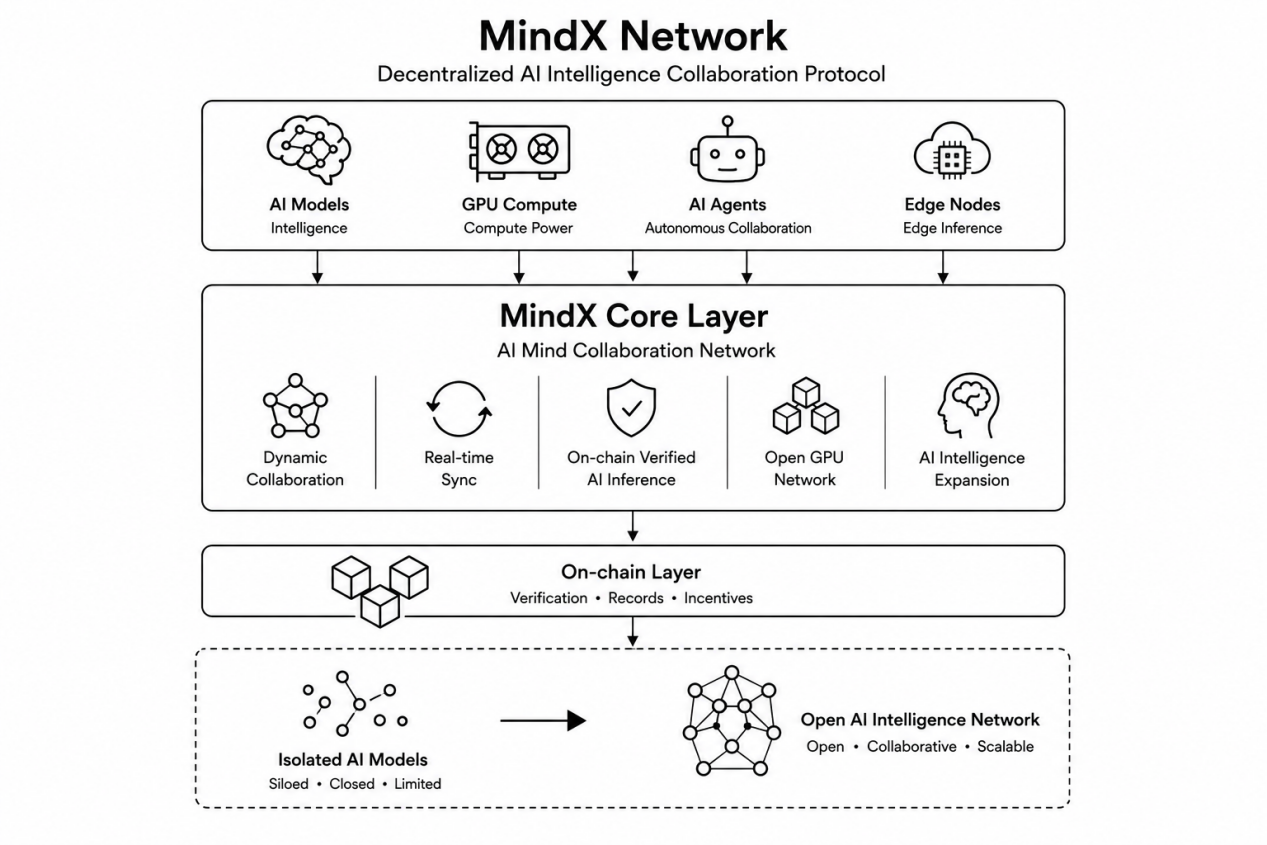
MindX is a distributed computing protocol for AI thought simulation and dynamic intelligent coordination.
MindX integrates:
- AI models
- GPU compute
- AI Agents
- Edge inference nodes
into a unified AI cognitive coordination network.
Its core value includes:
- Dynamic coordination capability
- Real-time information synchronization
- On-chain verifiable AI inference
- An open GPU network
MindX aims to move AI from:
“Isolated models”
into:
An “open intelligent network.”
2.2Functional Modules and Services
MindX adopts a modular AI network architecture.
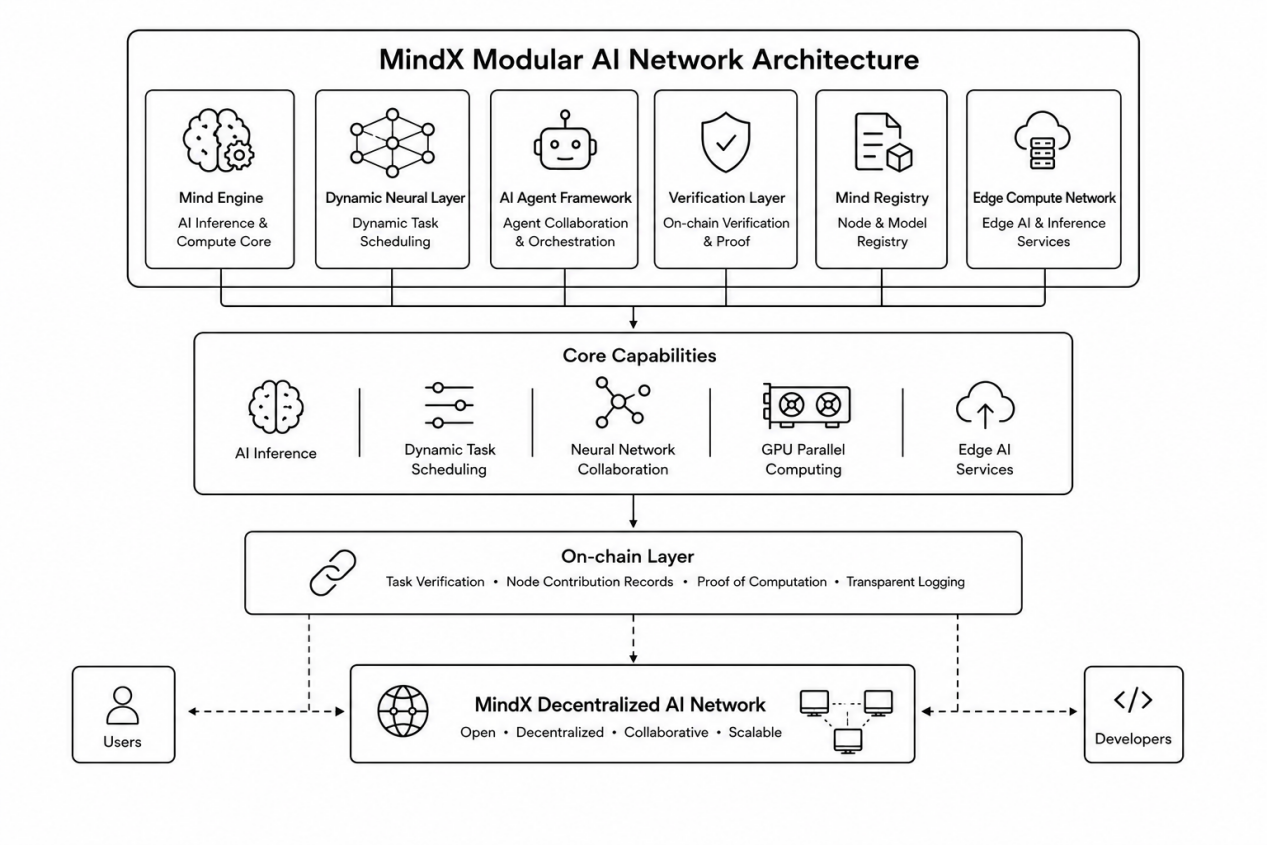
The core modules include:
- Mind Engine
- Dynamic Neural Layer
- AI Agent Framework
- Verification Layer
- Mind Registry
- Edge Compute Network
The system supports:
- AI inference
- Dynamic task scheduling
- Neural network coordination
- GPU parallel computing
- Edge AI services
All tasks and node contributions are verified and recorded through on-chain structures.
2.3Positioning and Target Users
MindX is positioned as:
“Future AI cognitive network infrastructure.”
It primarily serves:
- AI developers
- GPU node operators
- AI Agent teams
- Edge AI platforms
- Automated intelligent systems
MindX aims to provide developers with:
- Open GPU compute
- AI network coordination capabilities
- Real-time inference services
- Dynamic AI task networks
and to drive the long-term openness of AI infrastructure.
2.4Techno-Economic Ecosystem Strategy
MindX's ecosystem strategy is built around:
- AI cognitive coordination
- GPU network expansion
- A dynamic task economy
- The AI Agent ecosystem
and builds upon these pillars.
On the technical side, MindX will continuously optimize:
- Mind Engine
- AI coordination systems
- The edge computing layer
- On-chain verification mechanisms
On the economic side, growth is driven through:
- Token incentives
- Node rewards
- AI service settlement
- Dynamic contribution mechanisms
to drive long-term ecosystem growth.
MindX aims to build an open AI cognitive economy network.
CHAPTER 03
Technical Architecture
3.1Principles of the MindX Computing Framework
MindX is built on a distributed AI cognitive computing framework.
The entire system combines:
- GPU parallel computing
- Edge AI inference
- Dynamic task networks
- On-chain verification mechanisms
to achieve AI cognitive coordination.
Traditional AI networks typically execute tasks on fixed GPU clusters, whereas MindX places greater emphasis on:
- Real-time task flow
- AI Agent interoperation
- Neural-level information synchronization
- Dynamic resource coordination
The system splits AI inference tasks into multiple dynamic computing units and distributes them across different nodes for synchronized execution.
Through this structure, MindX aims to establish the infrastructure for a future open AI cognitive network.
3.2Off-Chain Inference and On-Chain Verification
MindX adopts an:
“Off-chain AI inference + on-chain verification”
architecture.
High-performance AI inference tasks execute on GPU nodes and the edge network.
After completing inference, the system synchronizes:
- Task results
- Node contributions
- Inference proofs
- Dynamic state data
to the on-chain verification layer.
This structure delivers:
- High performance
- Low latency
- High trustworthiness
- Open coordination capability
It also reduces on-chain load and GPU costs.
MindX aims to achieve:
“Verifiable AI inference.”
3.3Modular Smart Contracts
MindX uses modular smart contracts to manage the AI network.
The core modules include:
- Task Contract
- Verification Contract
- Reward Contract
- Agent Contract
- Node Registry
The Task Contract manages AI task requests;
the Verification Contract verifies node contributions;
the Reward Contract handles revenue settlement;
and the Agent Contract manages AI Agent behavior.
Different modules can be freely combined to adapt to:
- AI Agent networks
- Edge AI services
- GPU inference marketplaces
- Automated AI systems
3.4Composable Execution Pipeline
MindX introduces the concept of the “Composable Mind Pipeline (CMP).”
The complete AI inference flow includes:
User → Agent → Executor → Verifier → Settlement
Specifically:
- User: initiates the AI request
- Agent: coordinates task logic
- Executor: executes GPU inference
- Verifier: verifies task results
- Settlement: completes revenue settlement
This structure improves:
- AI coordination efficiency
- Task concurrency
- GPU utilization
- Network scalability
MindX hopes that future AI networks will operate in continuous coordination, like a nervous system.
3.5Dynamic Neural Layer
The Dynamic Neural Layer is MindX's dynamic neural coordination layer.
This layer is used to:
- Synchronize AI Agents
- Coordinate node communication
- Migrate tasks dynamically
- Link edge inference
The system dynamically adjusts the AI network structure based on:
- Node status
- GPU load
- Network latency
- Task priority
adjusting it dynamically as conditions change.
The Dynamic Neural Layer is the core coordination layer of the entire MindX AI cognitive network.
3.6Security, Scalability, and Performance
MindX's architecture is designed around:
- Security
- Scalability
- Real-time performance
as its design goals.
The system improves network stability through:
- On-chain verification
- Dynamic task isolation
- Edge node synchronization
- GPU coordination mechanisms
improving network stability.
At the same time, MindX supports:
- Horizontal multi-node scaling
- Edge AI expansion
- Real-time inference networks
- Dynamic Agent coordination
Together, these form a high-performance AI cognitive network. MindX hopes that future AI networks will scale continuously and operate stably over the long term.
CHAPTER 04
Core Applications
4.1AI Cognitive Inference Verification
One of MindX's core capabilities is AI cognitive inference verification.
Traditional AI inference typically cannot verify its:
- Authenticity
- Execution process
- Node contributions
MindX verifies:
- Inference results
- GPU execution records
- Task states
- Dynamic coordination data
through on-chain structures.
This moves AI inference from “black-box output” toward a “verifiable AI network.”
4.2Agent Framework
MindX provides an open AI Agent Framework.
Different AI Agents can:
- Share task states
- Synchronize inference logic
- Make collaborative decisions in real time
- Dynamically allocate resources
The entire Agent Framework supports:
- Automated AI networks
- Edge intelligence coordination
- GPU inference interoperation
- Multi-Agent collaborative tasks
MindX aims to drive long-term open coordination among future AI Agents.
4.3AI Assetization
MindX supports the assetization of AI models and inference capabilities.
This includes:
- AI model access rights
- GPU inference services
- AI Agent networks
- Dynamic AI service capabilities
All of these can become on-chain digital assets.
Developers can earn long-term returns through AI service calls, GPU network coordination, and dynamic task execution.
MindX aims to form an open AI cognitive economic system.
4.4Enterprise Automation Integration
MindX supports enterprise-grade AI automation integration.
Enterprises can connect quickly through:
- APIs
- Smart contracts
- AI Agent systems
- GPU inference services
for fast access to the MindX Network.
The system supports:
- Intelligent customer service
- Automated risk control
- AI decision systems
- Edge AI services
MindX aims to drive the long-term openness of AI automation.
4.5Developer Ecosystem
MindX places great importance on building the developer ecosystem.
The system provides:
- SDKs
- APIs
- Developer documentation
- AI Agent toolchains
- GPU inference interfaces
Developers can quickly:
- Deploy AI models
- Create AI Agents
- Access GPU services
- Participate in AI network coordination
MindX aims to build a global, open AI development ecosystem.
CHAPTER 05
Tokenomics
5.1MindX Token Overview
The MindX Token ($MINDX) is the native utility token of the MindX Network, with a fixed total supply of 300,000,000 (300 million). It is the core medium of value within the AI cognitive network.
$MINDX is primarily used for:
- AI inference settlement
- GPU node rewards
- Dynamic task coordination
- AI Agent scheduling
- DAO governance participation
Developers can use $MINDX to access:
- GPU inference services
- AI Agent networks
- Edge AI resources
- Dynamic cognitive computing capabilities
Node operators, in turn, contribute:
- GPU compute
- Edge inference resources
- Dynamic task coordination capabilities
to earn corresponding returns.
Through the Token, MindX aims to build an open AI cognitive economic system.
5.2Node Incentive Mechanism
MindX adopts a dynamic reward mechanism based on real AI contributions.
Nodes participate in:
- AI inference
- Dynamic task execution
- Edge AI services
- AI Agent coordination
to earn corresponding Token rewards.
The system dynamically adjusts rewards based on:
- Node stability
- GPU performance
- Task completion efficiency
- Real-time coordination capability
- AI inference quality
with rewards adjusted accordingly.
Nodes that operate stably over the long term receive:
- Higher task weights
- Priority scheduling
- Governance participation rights
MindX aims to continuously expand the global AI cognitive node network.
5.3Token Circulation Mechanism
MindX's token circulation is deeply tied to real demand from the AI network.
Activities including:
- AI inference services
- Agent coordination networks
- GPU task execution
- Edge AI scheduling
continuously consume $MINDX.
Developers pay tokens to access AI services;
nodes earn revenue by providing computing resources.
The entire ecosystem forms:
“Growing AI demand → Increased GPU and Agent usage → Higher node revenue → Expanded network scale”
— a long-term cyclical structure.
MindX aims to build a continuously growing AI cognitive economy network.
5.4DAO and Governance Rights
$MINDX is also a governance token.
Holders can participate in:
- Protocol upgrades
- AI network rule adjustments
- Ecosystem fund governance
- Node governance coordination
- Future roadmap planning
All governance proposals are executed through on-chain structures.
MindX aims to drive the AI network toward long-term open autonomy.
5.5Deflation and Long-Term Value Model
MindX will adopt a long-term dynamic deflationary structure.
A portion of protocol revenue is allocated to:
- Ecosystem buybacks
- The node reward pool
- A long-term governance fund
- Network expansion reserves
As the AI network grows in scale, demand for GPU and AI Agent usage will continue to rise.
Through real AI demand, node coordination expansion, and the token consumption mechanism, MindX aims to strengthen the long-term stability of the entire AI cognitive network.
CHAPTER 06
Security & Governance
6.1Security Principles
MindX's security system is built around:
- Trusted nodes
- On-chain verification
- Auditable AI inference
- Dynamic task isolation
as its foundation.
The system emphasizes: “AI network security first.”
All nodes undergo:
- Identity verification
- Contribution assessment
- On-chain reputation recording
thereby reducing the risk of malicious nodes.
6.2Node Reputation System
MindX introduces a dynamic node reputation mechanism.
The system continuously records:
- Task completion rates
- GPU online status
- AI inference quality
- Coordination stability
- Historical behavior records
Nodes with higher reputations receive:
- Higher task priority
- Higher reward weights
- More governance rights
Nodes with abnormal reputations may face:
- Task restrictions
- Reduced earnings
- Lowered governance rights
and similar measures.
6.3AI Inference Verification
One of MindX's core security capabilities is AI inference verification.
The system synchronizes:
- Task hashes
- GPU execution states
- AI inference digests
- Dynamic coordination data
to the on-chain verification layer.
This gives the AI network:
- Transparency
- Trustworthiness
- Auditability
MindX aims to drive future AI inference toward long-term verifiability.
6.4DAO Governance Mechanism
MindX adopts a DAO governance structure.
Community members can participate through:
- Submitting proposals
- On-chain voting
- Governance coordination
to take part in the network's development.
Governance covers:
- Protocol upgrades
- AI network parameters
- Node rule adjustments
- Ecosystem partnership expansion
MindX aims to build a long-term open, autonomous AI network.
6.5Long-Term Network Governance
MindX's governance goal is not only protocol management,
but also driving the long-term collaborative evolution of the AI network.
In the future, MindX will continuously expand:
- AI Agent governance capabilities
- GPU network coordination
- Edge AI infrastructure
- Automated task networks
and gradually advance:
“AI network autonomy.”
MindX hopes that future AI networks will continuously self-expand and coordinate over the long term.
CHAPTER 07
Ecosystem & Roadmap
7.1Phase One: Foundation Network Deployment
MindX will complete:
- Mind Engine
- Core GPU Nodes
- Verification Layer
- Agent Framework
along with other foundational module deployments.
A developer test environment will also be opened.
7.2Phase Two: AI Coordination Expansion
MindX will expand:
- The AI Agent network
- Edge AI inference
- Dynamic task coordination
- The distributed GPU network
and bring more AI services into the ecosystem.
7.3Phase Three: Open AI Cognitive Network
MindX aims to build:
- A global AI cognitive layer
- A real-time Agent coordination system
- A dynamic AI information-flow network
- An open intelligent computing market
Future AI nodes will continue to coordinate and evolve.
CHAPTER 08
Conclusion
8.1Conclusion
MindX aims to move AI infrastructure into:
The “era of the cognitive coordination network.”
Future AI will no longer be a single model,
but will gradually form:
- AI Agent networks
- GPU coordination systems
- A dynamic task internet
- An open intelligent ecosystem
MindX achieves this through:
- AI thought simulation
- Dynamic neural coordination
- On-chain inference verification
- An open GPU network
building the infrastructure of the future AI network.
MindX hopes to work with developers, GPU nodes, and AI communities worldwide to drive the continued development of the next-generation AI cognitive network.
CHAPTER 09
Mining Guide
A practical reference for participating in MindX mining. The method names and call flow below follow the current guide; always verify the deployed contract ABI and network configuration before sending a transaction.
9.1Mining Overview
MindX supports two contribution paths: Compute-PoC for independent compute contribution and Stake-to-Validate for staking-based task acceptance and verification. Both paths use the MindX mining pool as the reward settlement contract.
| Parameter | Value | Description |
|---|---|---|
| Token | $MINDX | MindX native utility token |
| Fixed total supply | 300,000,000 $MINDX | Confirmed project supply |
| Token contract | 0x09EfFA74Bc0f0781CE1D7cFB5c14c10Af426A14E | MindX token contract address |
| Mining pool | 0xc0b991287b0e79755eC71c2789C315974133bABC | MindX mining pool contract address |
| Mining mechanisms | Compute-PoC + Stake-to-Validate | Contribution and validation paths described in this guide |
| Network and RPC | Configure for the deployed network | The chain and RPC endpoint must be confirmed before use |
The guide preserves the original contract method names and ethers.js call style. The addresses above are confirmed MindX addresses; the network, deployed ABI, reward parameters, and validator policy remain authoritative at the contract and official network level.
- Compute-PoC submits a verifiable compute solution through the mining pool.
- Stake-to-Validate uses validator registration, task completion, and signed reward authorization.
- Wallets must keep the private key local and must hold the network gas token for transactions.
- Never send a private key or signing secret to a support contact or website.
9.2Compute-PoC
Compute-PoC (Proof of Compute) is the independent compute contribution path. Nodes use GPUs, CPUs, or edge devices to complete work and submit a verifiable proof to the MindX mining pool. Rewards are contribution-driven rather than based only on hash competition.
| Parameter | Value | Description |
|---|---|---|
| Total supply | 300,000,000 $MINDX | Fixed project supply |
| Reward model | Contribution-based | The deployed reward logic determines the final amount |
| Difficulty adjustment | Defined by the mining pool | Read the live contract value before mining |
| Mining target | Defined by the mining pool | Use the current target returned by the contract |
| Mining pool | 0xc0b991287b0e79755eC71c2789C315974133bABC | All Compute-PoC submissions target this contract |
The contribution model described by this guide considers compute contribution, task quality, and historical reputation. The contract and network implementation determine how these factors are applied.
- Contribution value: actual compute resources contributed by the node.
- Task quality: accuracy, efficiency, and stability of completed work.
- Historical reputation: the node's long-term on-chain record.
digest = keccak256(keccak256(challengeNumber + minerAddress + nonce))

uint256(digest) <= miningTargetThe following setup is the original guide's baseline. Confirm the supported operating system, Node.js version, RPC endpoint, and deployed ABI before running it.
npm install ethers@6const { ethers, keccak256, solidityPacked } = require("ethers");
const CONFIG = {
RPC_URL: "https://your-mindx-rpc-url",
TOKEN_CONTRACT: "0x09EfFA74Bc0f0781CE1D7cFB5c14c10Af426A14E",
MINER_CONTRACT: "0xc0b991287b0e79755eC71c2789C315974133bABC",
PRIVATE_KEY: "0x...", // Keep your private key secure
};
const MINER_ABI = [
"function mint(uint256 nonce) external returns (bool)",
"function getChallengeNumber() external view returns (bytes32)",
"function getMiningTarget() external view returns (uint256)",
"function getMiningReward() external view returns (uint256)",
"function checkMintSolution(uint256 nonce, address miner) external view returns (bool)",
];
class MindXMiner {
constructor() {
this.provider = new ethers.JsonRpcProvider(CONFIG.RPC_URL);
this.wallet = new ethers.Wallet(CONFIG.PRIVATE_KEY, this.provider);
this.contract = new ethers.Contract(
CONFIG.MINER_CONTRACT,
MINER_ABI,
this.wallet,
);
this.minerAddress = this.wallet.address;
}
async initialize() {
this.challengeNumber = await this.contract.getChallengeNumber();
this.miningTarget = await this.contract.getMiningTarget();
const reward = await this.contract.getMiningReward();
console.log("Current Reward: " + ethers.formatEther(reward) + " $MINDX");
}
calculateHash(nonce) {
const innerHash = keccak256(
solidityPacked(
["bytes32", "address", "uint256"],
[this.challengeNumber, this.minerAddress, nonce],
),
);
return BigInt(keccak256(solidityPacked(["bytes32"], [innerHash])));
}
checkSolution(nonce) {
const digest = this.calculateHash(nonce);
return digest <= this.miningTarget;
}
async mine() {
let nonce = BigInt(Math.floor(Math.random() * Number.MAX_SAFE_INTEGER));
while (true) {
if (this.checkSolution(nonce)) {
console.log("Found valid compute proof! Nonce: " + nonce);
const tx = await this.contract.mint(nonce);
await tx.wait();
console.log("Compute-PoC mining successful!");
await this.initialize();
}
nonce++;
}
}
}
async function main() {
const miner = new MindXMiner();
await miner.initialize();
await miner.mine();
}
main().catch(console.error);9.3Stake-to-Validate
Stake-to-Validate is the staking-based task acceptance and verification path. After meeting the MindX staking and validator requirements, a node can participate in model training verification, gradient checks, state arbitration, or other tasks made available by the network. Reward authorization can use the signed-call flow shown below; the deployed contract remains the source of truth.
- AI model training verification
- Gradient consistency checks
- State arbitration
- Ecosystem incentive distribution
- Long-term validator participation
| Feature | Compute-PoC | Stake-to-Validate |
|---|---|---|
| Mining method | On-chain compute proof submission | Signed authorization after task completion |
| Reward amount | Determined by contribution and deployed reward logic | Specified by the task and authorization |
| Entry requirement | A compatible node and wallet | Validator registration and the required $MINDX stake |
| Compute load | Active compute contribution | Verification and arbitration tasks |
| Use case | Independent compute contribution | Task rewards, model verification, and governance-related work |
| Block limit | Defined by the deployed pool | Defined by the deployed pool |
- An Ethereum-compatible wallet address.
- The network gas token for registration and reward transactions.
- $MINDX for the minimum stake defined by the validator policy.
- Official validator registration and any required approval or signature.
- Confirm the official MindX network, staking policy, and validator requirements.
- Submit the wallet address and intended validator use case through the official process.
- Receive the authorization required by the deployed registration flow.
- Call the registration function, then submit authorized task rewards.
const { ethers } = require("ethers");

const CONFIG = {
  rpcUrl: "https://your-mindx-rpc-url",
  tokenAddress: "0x09EfFA74Bc0f0781CE1D7cFB5c14c10Af426A14E",
  minerAddress: "0xc0b991287b0e79755eC71c2789C315974133bABC",
  privateKey: "0x...", // Keep your private key secure
};

const MINER_ABI = [
  "function registerFlexUser(address user, uint256 deadline, bytes32 nonce, uint8 v, bytes32 r, bytes32 s) external",
  "function mintFlex(address miner, uint256 amount, uint256 deadline, bytes32 signatureNonce, uint8 v, bytes32 r, bytes32 s) external returns (bool)",
  "function isFlexUser(address user) external view returns (bool)",
];

class StakeValidatorClient {
  constructor(config) {
    this.provider = new ethers.JsonRpcProvider(config.rpcUrl);
    this.wallet = new ethers.Wallet(config.privateKey, this.provider);
    this.contract = new ethers.Contract(
      config.minerAddress,
      MINER_ABI,
      this.wallet,
    );
  }

  async checkValidatorStatus() {
    return await this.contract.isFlexUser(this.wallet.address);
  }

  async register(signature) {
    const { user, deadline, nonce, v, r, s } = signature;
    const tx = await this.contract.registerFlexUser(
      user,
      deadline,
      nonce,
      v,
      r,
      s,
    );
    return await tx.wait();
  }

  async mint(signature) {
    const { miner, amount, deadline, nonce, v, r, s } = signature;

    if (Date.now() / 1000 > deadline) {
      throw new Error("Signature expired");
    }

    const tx = await this.contract.mintFlex(
      miner,
      amount,
      deadline,
      nonce,
      v,
      r,
      s,
    );
    return await tx.wait();
  }
}9.4Mining Statistics
The original statistics call reads the current reward, difficulty, epoch count, distributed tokens, and pool balance from the mining contract. Field indexes depend on the deployed return tuple, so verify the ABI before using these values in production.
async function getMiningStats(contract) {
  const stats = await contract.getMiningStats();

  return {
    currentReward: ethers.formatEther(stats[0]),
    difficulty: stats[1].toString(),
    epochCount: stats[3].toString(),
    tokensDistributed: ethers.formatEther(stats[6]),
    poolBalance: ethers.formatEther(stats[12]),
  };
}9.5Common Errors
These error names are retained from the original method guide. The deployed MindX contract may use a different custom error or revert message; use the verified ABI and transaction trace when diagnosing a failure.
| Error | Description | Solution |
|---|---|---|
| NotFlexUser | Caller is not a registered Stake Validator | Complete the official validator registration first |
| AlreadyMinedInBlock | The current block has already been used | Wait for the next eligible block |
| InvalidProofOfWork | The submitted compute proof is invalid | Refresh the challenge and retry |
| SignatureExpired | The authorization signature has expired | Request a new authorization |
| NonceAlreadyUsed | The authorization nonce has already been used | Request a new nonce and signature |
| InsufficientPoolBalance | The mining pool cannot cover the requested reward | Reduce the request or wait for pool funding |
9.6Contract References and Support
| Reference | Address or status |
|---|---|
| MindX token contract | 0x09EfFA74Bc0f0781CE1D7cFB5c14c10Af426A14E |
| MindX mining pool | 0xc0b991287b0e79755eC71c2789C315974133bABC |
| RPC endpoint | Use the official endpoint for the deployed MindX network |
| Validator support | Use the official MindX community or support channel |
Before using the code examples, confirm the official network, RPC endpoint, contract ABI, validator policy, and support channels. The contract addresses above are the confirmed MindX references for this guide; never trust a request for your private key or seed phrase.